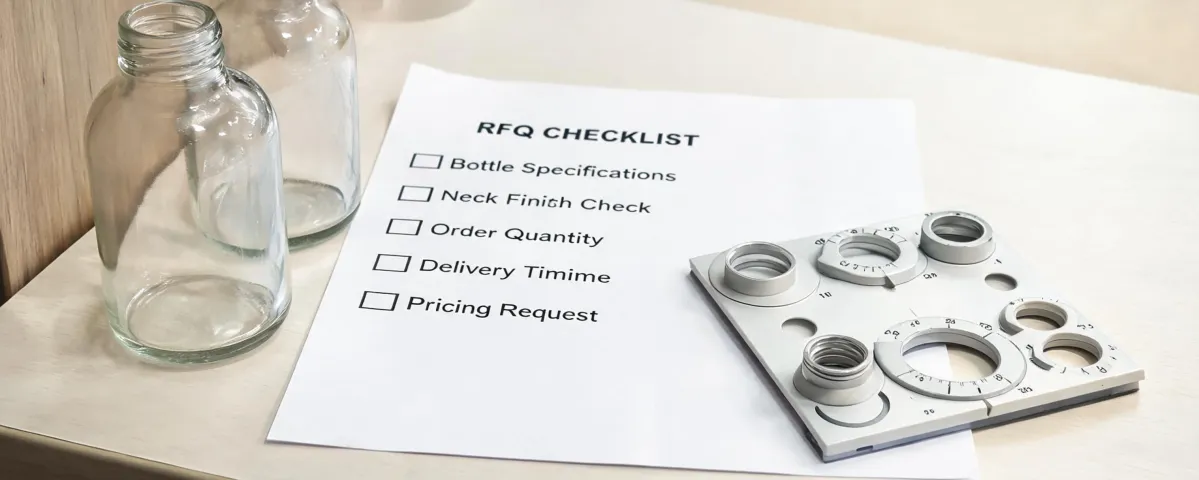
When you're sourcing Boston round glass bottles against a hard deadline, the cheapest quote isn't the lowest cost. The cheapest quote is the one that comes with a delivery date you can actually plan around.
I'll say it outright: I pay a 15–20% premium for confirmed delivery dates. Not because I have budget to burn — I manage roughly $180,000 in annual packaging spend and track every invoice in our cost system — but because six years of data have taught me one thing: uncertain cheap is more expensive than certain premium.
The mistake I almost made in year one
In my first year managing packaging procurement, I made a classic beginner error: I assumed "in stock" meant "ships fast."
We needed 500 units of a 5 gallon round glass bottle for a client deadline. I collected quotes. Supplier A came in at $5.20 per unit, "three weeks." Supplier B quoted $5.70, "12 business days delivery." I almost chose A to save $250.
So glad I asked one question first: "Is three weeks production time or delivery time?"
Turns out, Supplier A's "three weeks" was production only. Freight and pallet handling would add another two weeks. The client deadline was in four weeks. We ran the TCO math — that quote wasn't cheaper. It was incomplete.
We went with B. Higher unit price, but the delivery date was a confirmed commitment I could build a schedule around. Months later, I learned A had a roughly 30% on-time delay rate on similar SKU orders. That $250 "saving" would've cost us about $1,800 in expediting fees, missed milestones, and team overtime.
Why the cheapest quote often isn't
Here's the counterintuitive part. In packaging procurement, the lowest quote often comes from a supplier who doesn't really understand your SKU.
Take our 5 gallon round glass bottle spec — we reference it internally as SKU bt5gg015517. That size requires specific mold tooling, heavier glass, and dedicated freight pallets. A supplier unfamiliar with the format sees a unit price. They don't see the adjustment costs, the freight constraints, or the scheduling risk.
A quote looks lower sometimes simply because the supplier hasn't priced in what it actually costs to deliver it. That doesn't mean it's cheaper. It means it's unreliable.
Suppliers who handle these formats regularly tend to quote more conservatively and more completely. The number's higher, but it's a number you can actually work with.
The math behind paying for certainty
I run a simple expected-cost comparison every time someone asks why we don't just take the cheapest quote.
Say we're sourcing 500 bottles at around $6,000 total order value:
- Supplier A: $5,700 product cost, but historical data shows roughly 30% probability of late delivery. Each late delivery costs us about $1,200 in knock-on effects. Expected cost: $5,700 + ($1,200 × 0.3) = $6,060.
- Supplier B: $6,300 product cost, with a documented ~5% delay rate. Expected cost: $6,300 + ($1,200 × 0.05) = $6,360.
On paper, A is slightly cheaper. But here's the thing — when A misses, the delay cost isn't always $1,200. Sometimes it's a missed client launch. Sometimes it's a contractual penalty. Sometimes it's the entire relationship.
That's when B stops being the "expensive" option and becomes the only reasonable one. This is exactly the kind of hidden TCO calculation I've been running for six years, and it's why I stopped chasing the lowest unit price on wholesale Boston round glass bottles a long time ago.
"But isn't paying for speed a waste?"
I hear this pushback regularly. Usually from finance: "Can't we just order earlier and skip the rush fees?"
In theory, yes. In practice, ordering early has its own costs. Longer inventory carrying time means capital tied up in stock. And client demand can shift between when the order arrives and when it's needed.
More importantly, not everything can be planned six weeks out. We've had clients call ten days before an event needing a replenishment order. The premium hurts. I still pay it.
Because when an order is truly urgent, missing the deadline costs several times what the premium does. And in those moments, the cheap supplier doesn't have the SKU you need anyway — they're quoting you a different run size with a different lead time.
The premium isn't just buying faster production. It's buying a supplier willing to adjust their schedule for your order. That reliability has a real value, even if it doesn't show up on the line-item quote.
What I ask suppliers now
My sourcing policy is simple: for time-sensitive orders, a quote must include a specific delivery date — not a production lead time. If the supplier can't give me a date I can plan against or walk away from, I mark the quote as unusable.
Three questions I always ask:
- "When you say X days, is that production time or delivery time?"
- "What's the confirmed ship date if I place the order today?"
- "Can you commit to that date in writing on the PO?"
If the answer is a date, I can plan. If the answer is a range, I'm planning against the worst case — which changes the entire conversation.
Yes, this means paying more sometimes. It also means ordering ahead to avoid premiums. There's something satisfying about a delivery that lands on the exact date you expected. After enough late shipments and emergency re-bookings, a confirmed date is worth more than a discount.
If you're sourcing wholesale Boston round glass bottles against a hard deadline, ask for the delivery date first. If the answer comes with a lot of "probably" and "should be," you've found your risk — no matter how low the unit price looks.