Boston Round Glass Bottle Sourcing inquiry brief
This page is the written intake for Boston Round Glass Bottle Sourcing. It is an independent packaging desk that routes a comparable factory request. It does not occupy a published building, so no street, switchboard, or live map coordinate is listed.
A public packaging coordinator may show a brief-first intake. That observation is a process reference, not a claim that this desk shares that network or lead time. No discount percentage is printed because this site has no same-spec quote pair on file.
-
Named construction
Write boston round only when the rounded shoulder and continuous-thread neck match that form. Record capacity in ml or L and the neck finish (for example 20-400 or 24-410). Flint, amber and cobalt are separate color lots. A measured 5 gallon round glass bottle belongs on another line because wall mass, pallet tier count and closure family change.
-
Quantity and unit
State pieces or cartons by specification. Do not drop gallons and millilitres into one price cell without the conversion the buyer used. Mold, plate or screen charges for applied print stay outside the piece cell. A pressure-sensitive label with flexographic printing, a die line and a rewind specification is a companion RFQ, not a hidden adder inside the bottle unit price.
-
Destination and documents
Give the receiving US state or ZIP, whether bottles ship empty, and the pack-out (divider carton versus pallet with layer pad). If the fill is food, oil or alcohol, ask the named lot for a food-contact or migration testing file. Glass can suit inert contact and shelf presentation; plastic may cut outbound weight and change oxygen transmission rate. That glass-versus-plastic choice is a buyer trade-off, not a slogan this desk certifies.
Optional target budget may list an amount or range, a currency, and a per-unit or total-order basis. High-end, mid-range, budget or undecided is a buying filter, not a factory grade this desk has audited. No existing quotation is required. After you submit, a live endpoint—if configured—routes the text. Until then treat the form as a template. No reply-hour SLA is claimed.
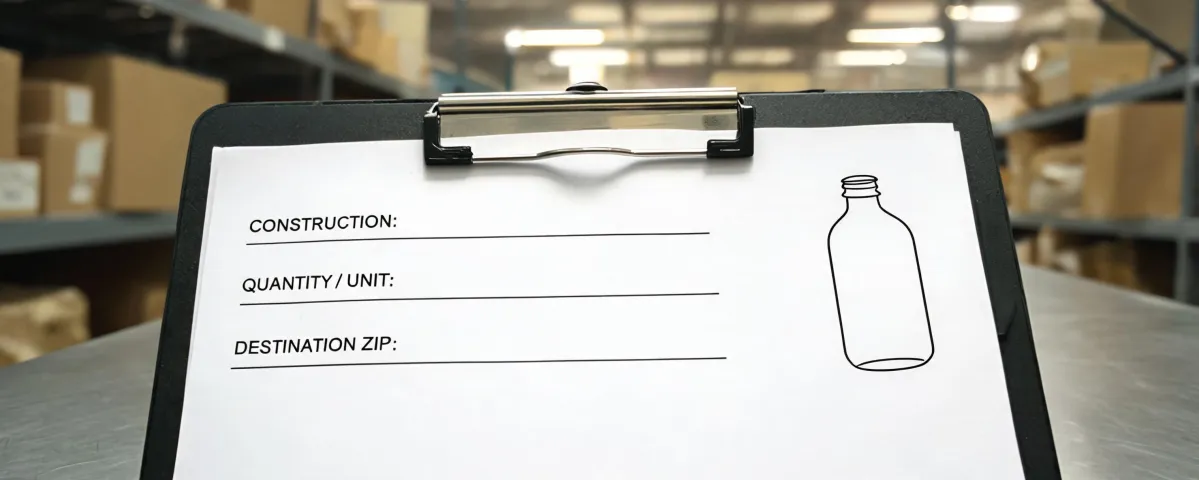
Send the same cells on every factory line
Name, work email, company and phone sit on two-column rows. Put the procurement requirement in the existing content field: product format, quantity, destination and the optional budget or preference notes. This form has no upload control; drawings can be offered after contact if a live endpoint exists. Submission starts a discussion; it does not place an order or lock a mold.